 Arogya Times
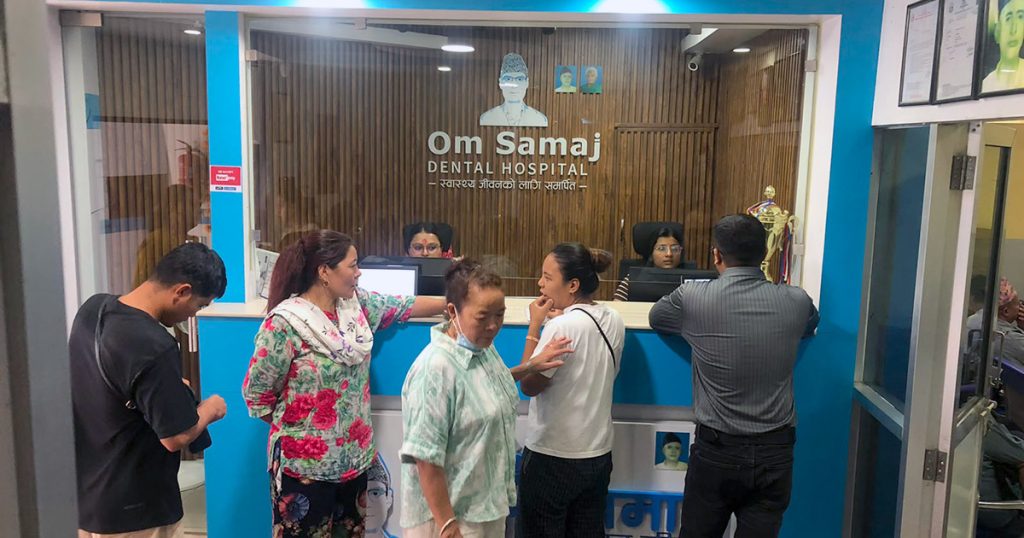
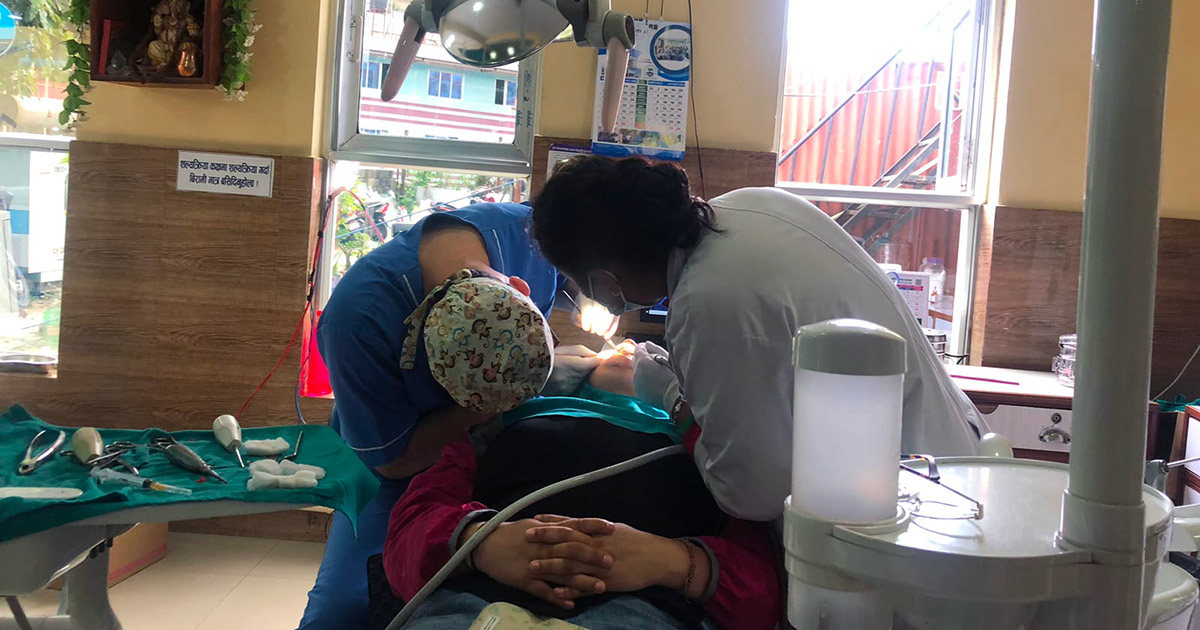
In the modern, high-tech corridors of the Om Samaj Dental Hospital in Kathmandu, Dr. Subhash Ghimire moves with the precision of a man who knows the value of every second. But to understand the journey of this renowned Oral and Maxillofacial Surgeon, one must look back to a time when his world was defined not by surgical masks and scalpels, but by the dust of cowsheds and the wild freedom of the Mahottari plains.
Childhood and Roots: From the Cowsheds of Mahottari
Dr. Ghimire’s origins are rooted in the rural landscapes of Nepal. While his family originally hailed from Manthali, Ramechhap, and later moved to Sindhuli, they eventually settled in the Gauribas village committee of Mahottari district (now Bardibas Municipality) after a devastating flood in 1965 (2022 BS) washed away their ancestral lands.
As a child, Subhash was far from the model student. He admits that he had no interest in studies and spent his days roaming forests, crossing rivers, and following buffaloes and cows near the family cowshed (goth). He was often considered “foolish” or “naughty” by those around him, and his father frequently had to use physical discipline to force him to attend the local government school. Until the fifth grade, he struggled even to recognize letters properly, preferring the freedom of nature over the confinement of a classroom.
His father, desperate to break this cycle of indifference, would often resort to physical discipline to drag him to the local government school. Subhash’s rebellion was so fierce that he once even told his father he would do the same to him when he grew up. He was, by his own definition, a “worst-case student.”
At that time, Mahottari was a land of stark contrasts—geographically accessible as a Terai district, yet profoundly underdeveloped and isolated in its social consciousness.
In those days, education was a rare luxury. The School Leaving Certificate (SLC), then known as the “Iron Gate,” was a mythical barrier; anyone who managed to pass it was instantly heralded as a “scholar” or “genius” (Vidwan) by the villagers. Healthcare was equally primitive. In a world where modern hospitals were a distant dream, anyone capable of administering a life-saving injection was reverently called a “Doctor,” regardless of their formal medical training.
The Turning Point: A Mother’s Pain
The trajectory of his life changed during a moment of deep emotional struggle. His mother fell severely ill and was in immense pain; young Subhash could do nothing but cry alongside her. When a local healthcare worker (referred to as a “doctor” in the village) arrived to give her an injection that provided immediate relief, his mother offered him life-changing counsel: “If you want to heal someone’s pain, you must study”.
This encounter ignited a “fire” within him. He realized that for people like him, there was no alternative to education. This sparked a profound shift in his mindset, moving from a boy who fled school to a man obsessed with learning.
The Struggle of the ‘Iron Gate’
The transition from a boy who fled school to a disciplined scholar was grueling. Because he had neglected his early education, his academic foundation was weak. He describes his middle-school years as “painful” as he struggled to understand basic concepts.
When he finally took the SLC exams, he passed in the Second Division. While he modestly calls this “barely passing” today, in the context of the time, it was a triumph that made him a “great man” in his village, where many families saw no one pass at all. This success gave him the confidence to pursue his Intermediate of Science (ISC), where he adopted a radical discipline: waking up at 2 AM every night to study. This relentless “payment” of sleep eventually earned him a First Division and paved the way for his surgical specialization.
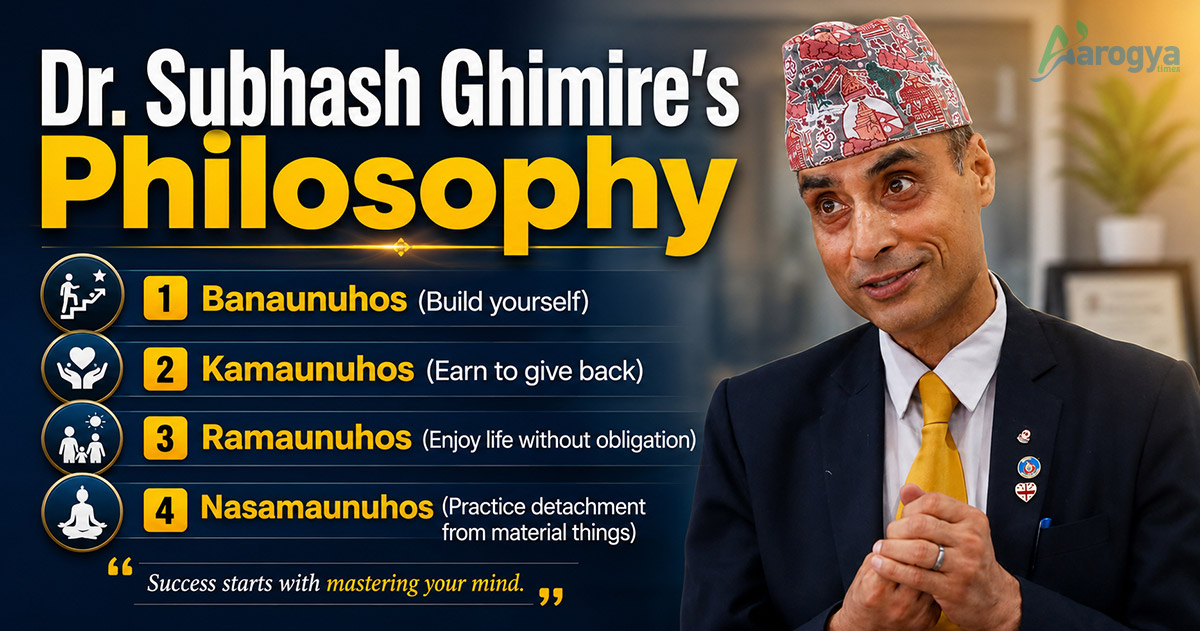
A Philosophy for Life: The Four Pillars of Success
Dr. Ghimire’s philosophy is built on the belief that “Success starts with mastering your mind”. He categorizes a successful life through four specific actions:
• Banaunuhos (Build Yourself): Invest in your physical health, education, and skills.
• Kamaunuhos (Earn): Earn as much as you can so that you have the resources to help others.
• Ramaunuhos (Enjoy): Find joy with your family and society; work for the sake of happiness, not just obligation.
• Nasamaunuhos (Don’t Cling): Understand that we bring nothing into this world and take nothing out. Practice detachment and focus only on your duties (karma).
He also advocates for a unique approach to mental mastery, where one must become the master of the mind rather than its slave. He practices “meditation in action,” whether eating, walking, or working, and maintains a disciplined sleep schedule, prioritizing the depth of sleep over the number of hours.
Inspiration and Social Mission
His primary inspirations remain his parents, whom he views as “living gods” more sacred than any temple or statue. He also credits Dr. M.S. Raju of Bangalore for significantly influencing his professional life.
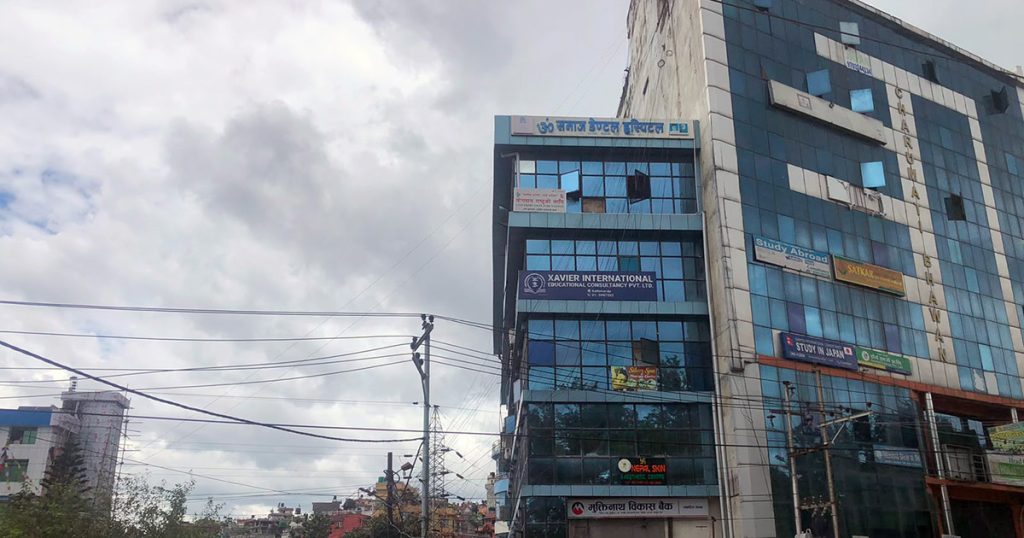
This sense of gratitude fuels his social mission at Om Samaj Dental Hospital. To ensure no one is deprived of care due to money, he introduced a 25-rupee lifetime membership for checkups. His goal is to create a “sustainable society” where oral health—which he claims can prevent 90% of all diseases—is accessible to every citizen.
Dr. Ghimire’s life story conveys a powerful message to the youth: your past does not define your future. By changing your mindset and developing disciplined habits, you can transform from a “worst-case” student into a leader of society.
Watch the Video
Arogya Times