 Arogya Times
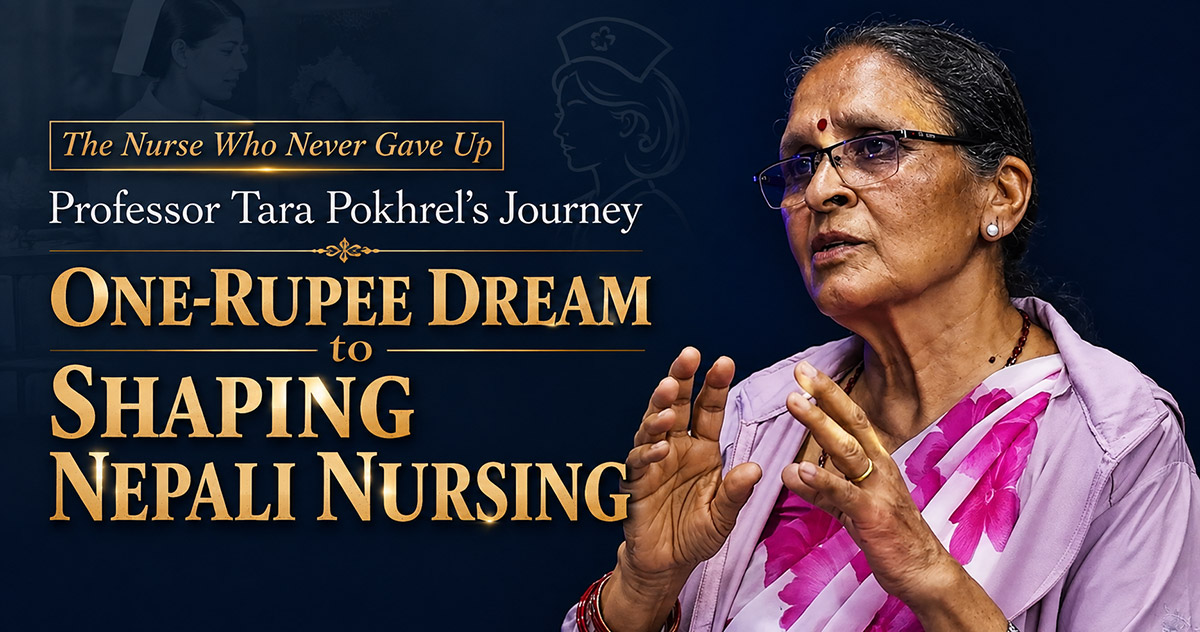
In the quiet corridors of Nepal’s medical history, one name resonates with the soft rustle of a white nurse’s uniform and the iron will of a pioneer: Professor Tara Pokhrel. Often described as a living history of Nepali nursing, her journey is not merely a professional timeline but a poignant saga of rebellion, healing, and a profound love for a nation that now stands at a crossroads.
—
The Syangja Sun and a One-Rupee Rebellion
Tara Pokhrel’s story begins in the emerald hills of Syangja, in an era where the destiny of a Brahmin girl was often sealed by the age of nine. While other girls her age were being prepared for marriage, Tara found an unlikely ally in her own perceived “clumsiness”. Whenever she was sent to cut grass or dig for firewood, she would return with a cut hand or a bruised eye. Seeing her inability to perform traditional farm chores, her parents eventually stopped sending her to the fields.
When a school finally opened in her village, she watched six boys walk toward a future she was told she couldn’t have. But Tara was a child of resolute decisions. Armed with a single Rupee and a heart full of fire, she walked to the market. She spent fifty paisa on a Varnamala (alphabet book) and the remaining fifty paisa on a slate and a khari (chalk/pencil) to write with. When she announced her intention to go to school, the village laughed. They told her she was at an age to be a bride, not a student. In response, she staged a hunger strike, refusing even the evening rotis until her mother, recognizing her daughter’s stubborn spirit, finally relented. Tara became the first girl in her area to step into a classroom, a small lamp lit against a vast darkness.
Her education quickly became a bridge for her community. In a village where many men had left to serve as Laures in India and British, the young Tara became the village scribe. She walked from house to house, writing letters for wives to send to their distant husbands. In return, she was rewarded with coconut and mishri (sugar candy), small sweetnesses that fueled her determination to keep learning.
The Calling: From Butwal to the Frontiers
The seeds of her nursing career were sown in a hospital room in Butwal, where she watched nurses in their pristine white uniforms caring for her sick mother. To the young Tara, they looked like angels of mercy, and though her parents were hesitant to send a teenage daughter away to study, the intervention of a family friend opened the door. She traveled to Nepalgunj to study nursing, passing her ANM in 2029 BS.
Her first job took her to the remote trails of Bhojpur. In those days, the life of a nurse was one of simple dignity and immense responsibility. Her salary as a permanent staff member was between 125 and 150 Rupees, a sum that allowed her to live comfortably, with monthly mess expenses for food costing only about 60 to 70 Rupees. She took pride in the fact that she never had to ask her parents for a single paisa for her books or clothes. From Bhojpur to Bir Hospital, and eventually becoming the first person in Nepal to receive a specialist nursing license after completing her Master’s degree, Tara’s path was one of constant ascent.
A Battle with the Silent Crab: The Cancer Journey
Perhaps the most emotional chapters of Tara’s life involve her confrontations with cancer. When her mother was 60, she was diagnosed with fourth-stage cervical cancer at a time when treatment options in Nepal were non-existent. Refusing to give up, Tara took her to Kolkata, where doctors gave the elderly woman a maximum of five years to live.
Tara turned to the wisdom of Ayurveda and the sanctity of the Tulasi (Holy Basil) plant. She encouraged her mother to drink tea made from Tulasi leaves and stems every day. Miraculously, her mother didn’t just survive five years; she lived until the age of 92, passing away in 2071 BS.
Years later, the “crab” returned for Tara herself in the form of breast cancer. Despite offers from her former students to fund her treatment abroad, she chose to stay in Nepal, trusting the medical system she had helped build. Today, eleven years later, she stands cancer-free, a testament to the power of timely treatment and an unbreakable will.
Pioneering Vision for School Nursing
In the heart of Nepal’s nursing history, Prof. Pokhrel stands as a figure of deep resilience, and her vision for the profession extends far beyond the sterile walls of a hospital. One of the most transformative chapters of her legacy was the birth of the School Nursing initiative, a concept she and her team pioneered (suggested to the government) during her tenure as the President of the Nursing Association of Nepal.
Drawing inspiration from global practices, Prof. Pokhrel saw the school nurse not merely as a medical provider for minor injuries, but as a vital health educator and a bridge to the community. In her storytelling, the school nurse becomes a mentor who empowers children to be the first line of defense for their families’ health.
A central part of this vision is teaching children to recognize “red flags” that adults might ignore. For instance, school nurses teach students that if a mother experiences bleeding after menopause, it is a serious sign that requires an immediate hospital visit—a lesson deeply personal to Pokhrel, whose own mother faced a late-stage cancer diagnosis. By educating the youth, the nurse effectively reaches the parents, turning every student into a health advocate who can spot symptoms of chronic cough, fever, or the dangers of mosquito-borne illnesses.
A Profession in Shadows: The Crisis of Nursing in Nepal
Today, the woman who once fought for the right to hold a pencil now fights for the soul of her profession. Professor Pokhrel speaks with a heavy heart about the state of nursing in Nepal. “Nurses are being produced only to be exported,” she laments. With over 42,000 nurses having already taken licenses to work abroad, the country is facing a catastrophic brain drain.
The problems are systemic: private hospitals pay measly salaries of 18,000 to 20,000 Rupees in a city where room rent alone can swallow half that amount. The nurse-to-patient ratio is often a staggering 1:20 in general wards, far from the ideal 1:6 required for quality care. Furthermore, the recent closure of 76 PCL (Certificate Level) nursing colleges has strangled the pipeline of new talent, creating a vacuum that Tara fears will soon force Nepal to “import” nurses just as it imports sugar or petrol.
A Vision for Healing: Suggestions for the State and the People
To the government, her message is urgent: Reopen the closed colleges and ensure that hospitals with 100 to 500 beds can run multiple levels of nursing education. She calls for a system where private sector salaries match government standards and where promotions and rotations to rural areas are handled with transparency rather than political favoritism.
To the general public, she offers the wisdom of a survivor: Prioritize health before it becomes a crisis. She urges people to move away from junk food and pesticides, returning to organic roots. Most importantly, she stresses that when facing a disease like cancer, family support and high morale are as vital as the medicine itself. “Don’t cry in front of the patient,” she advises, “give them the strength to fight”.
The Final Fear: A Nation of Empty Houses
Despite her many victories, a singular fear haunts Tara Pokhrel’s golden years. It is a fear shared by thousands of Nepali parents: the fear that their children, who have left for better lives abroad, will never return.
“I fear that one day, Nepal will become nothing more than an old age home,” she says softly. She worries that the very people meant to care for the next generation are being pushed out by a system that doesn’t value them.
Professor Tara Pokhrel’s life has been a long, beautiful, and often difficult walk from the Syangja hills to the highest echelons of Nepali medicine. She remains a beacon of hope, reminding us that while a single pencil can start a revolution, it takes a whole nation to sustain the heart of its healers. Her journey is an inspiration—a call to ensure that the “angels in white” can finally find a reason to stay home.
Watch the Video:
Arogya Times