 Arogya Times
A Childhood Marked by Silence and Soil
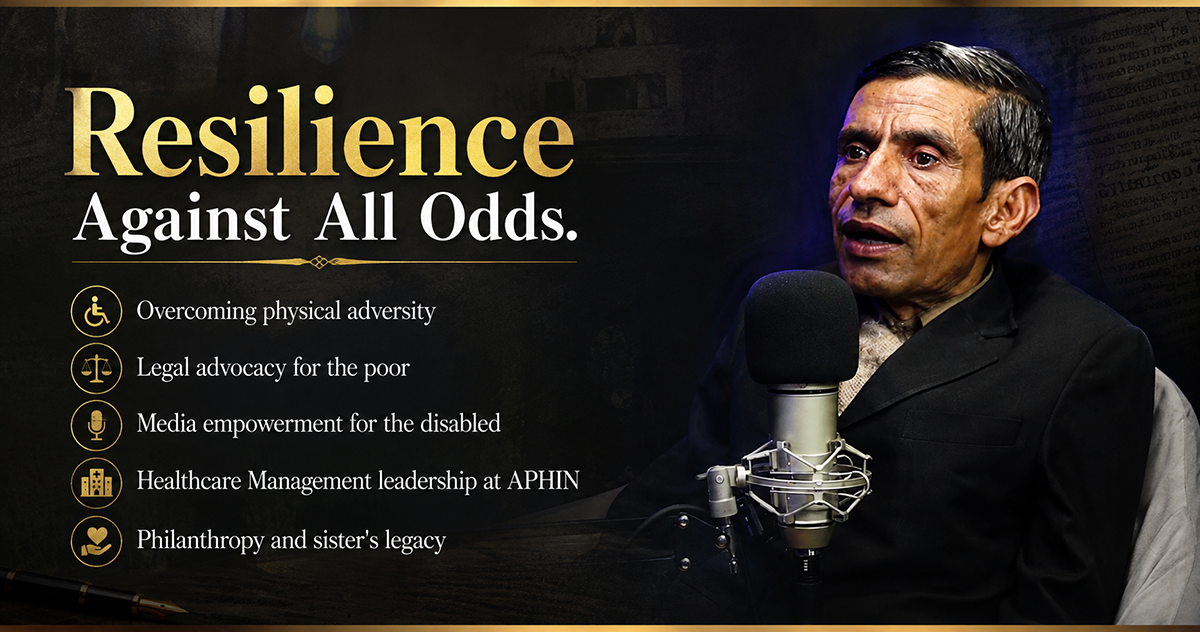
In the northeastern village of Dachi, Kathmandu, a young Mani Raj Paudel entered a world that felt as remote as a distant hinterland, despite sitting just miles from the nation’s bustling capital. As the youngest child in a modest family, his early days were shaped by the quiet rhythm of his father’s work at the post office, Sundhara, Kathmandu.
Life shifted irrevocably when Mani was only four years old. A severe fall—or perhaps the quiet onset of bone tuberculosis—permanently altered his body. In a community where daily survival relied on melapata, the shared rhythm of heavy physical labor, young Mani found himself sidelined. Unable to run alongside his peers or contribute to the fields, he existed in a silent space of isolation, forced to watch the world move forward without him.
Walking Through the Gauntlet of School
Education offered Mani a sanctuary, yet it came wrapped in psychological hardship. From grade one to ten, his school days were shadowed by relentless teasing. Students and teachers alike weaponized his small stature with cruel remarks, testing his spirit daily.
Yet beneath the quiet vulnerability lay an iron resolve. During his SLC board examinations, the classroom desks were too tall for his frame. Refusing to let circumstances dictate his fate, he stood on his feet for hours to write every exam paper. Though he initially failed three subjects—including English—defeat was never an option. Mani labored through sleepless nights until he cleared every single subject, proving that his determination far outmeasured his physical frame.
A Shield Against Injustice
Driven in part by a desire to conquer the legal realm, Mani entered Nepal Law Campus. Through sheer perseverance, he navigated the demanding I.L. and B.L. programs, eventually earning his official advocate license.
However, his heart heavyened as he encountered the harsher realities of the legal system. At the Supreme Court, he witnessed a lawyer demanding money from a destitute man before offering help—a moment that fractured his faith in traditional practice. Rather than pursuing personal profit, Mani redirected his purpose. He wants to serve poor and marginalized people with legal advocacy in free of cost if they approach him. He promisses his friends are ready to do same.
From Cold Rejections to Open Doors
The path from graduation to employment was a grueling endurance test. Prospective employers repeatedly judged his capability by his physical appearance. One stinging encounter left an enduring mark when an owner of organization was saying: “There are other organizations meant for the disabled—why has he come here?”
In his darkest hours, when the weight of rejection made a meaningful career feel distant, despair crept in. Yet hope arrived through unexpected allies. Daman Bahadur Amatya of San Miguel Beer gave Mani his first break, hiring him as an office boy and photocopier operator after numerous approach for the job for two years.
Gayatri: The Silent Light
Through every hardship, Mani’s life remained anchored by the memory of his elder sister, Gayatri Paudel. To him, she was his “sky, earth, sun, and moon”—the intellectual light of their family. When she passed away while he was in the ninth grade, it left a profound void in his heart.
To honor her memory, Mani established a social trust in her name, funding community health camps and outreach programs. His devotion remains timeless: during the festival of Tihar, he chooses to worship her photograph, holding off on traditional rituals until he can fulfill his dream of building a school or library in her name. For Mani, Gayatri remains the silent guardian who pulled him through his deepest trials.
A Union Bound by Purpose
Rejecting traditional, lavish wedding ceremonies that felt uncomfortable due to public scrutiny of his stature, Mani chose a simple “Stage Marriage” in 2060 BS. Held at the Information Department hall with support from the Kathmandu branch of the Federation of Nepali Journalists, the wedding was a statement of humility.
In an act of deep social responsibility, the couple donated the money saved from skipping a grand reception directly to the Journalist Federation and his sister’s trust. Today, Mani shares a warm home with his wife and three children—a living testament that a bond built on understanding outshines societal expectations.
The Power of the Written Word
Mani’s journey into journalism began almost by chance, inspired by the daily newspapers his father brought home for Gayatri. What started as short articles on tourism, environment, and social profiles for publications like Sunrise Nepal and Ghar Sansar eventually grew into a life’s calling.
Driven to empower others, Mani founded Saha Sandesh, a publication specifically designed to amplify the voices of the disabled community. The initiative turned the tables: individuals on crutches or in wheelchairs were no longer the subjects of sympathy, but the journalists holding the microphone. For Mani, the pen became a lasting tool for dignity and social change.
Building a Pillar in Healthcare
In 2063 BS, guided by his mentors Dr. Bhola Rijal and Sarala Rijal—whom he affectionately regards as his godparents—Mani joined the Association of Private Health Institutions of Nepal (APHIN). Starting as a part-time administrator earning a modest stipend, he organized the institution’s entire foundation from a single box of documents.
Over the years, through major national crises like the 2015 earthquake and the COVID-19 pandemic, Mani’s steady leadership helped steer the organization forward. His tireless dedication eventually saw him appointed as Chief Executive Officer (CEO). To Mani, APHIN is not merely an office—it is his life’s work and second home.
Balancing Policy with Practical Reality
With years of healthcare administration experience, Mani offers a thoughtful perspective on Nepal’s policy requiring private hospitals to provide 10% free care to underprivileged patients. While supporting the goal of helping those in need, he points out the operational ambiguities in regulations that fail to define whether the coverage applies to basic bed costs or extends to complex surgeries and medications.
He emphasizes that placing mandatory healthcare burdens solely on private hospital licensing—while other service industries face no equivalent mandates—requires constructive dialogue between the government and healthcare providers to build sustainable solutions.
Unmasking Myths: Defending Private Care
Mani firmly challenges the public narrative that labels private hospital owners as a “mafia.” Having worked alongside healthcare leaders for decades, he views these entrepreneurs as vital contributors who take immense financial risks to build critical infrastructure, generate employment, and keep advanced medical care within the country.
He attributes much of the friction to communication gaps, where isolated billing disputes or tragic medical outcomes are magnified without broader context. For Mani, the private health sector remains an essential pillar of national resilience—one that requires mutual trust, transparency, and a fair partnership with the state.
Watch the Video
Arogya Times